
In an ever-changing market, companies are asking a different question, do we really need another employee to answer customer questions, analyse data, or help write software code when AI can handle part of that work?
That is the part of the AI boom that deserves more attention. You have probably seen the headlines about layoffs, smaller teams, and employees being encouraged to use AI. For someone building a career in IT, it raises an uncomfortable question Is the widespread use of AI by companies a threat to jobs?
The answer is yes, for some roles and some workers. However, the picture is more complicated than AI taking everyone’s job. The pressure can show up through fewer openings, changing responsibilities, and higher expectations long before someone receives a termination email.
In today’s post, we are going to check out why IT companies are putting AI into employees’ hands, how this could change India’s IT services model, and what employees can actually do about it. Without further ado, let’s get started!
The Real Risk Isn’t Always Losing Your Current Job
When we discuss AI and jobs, layoffs usually get the most attention. But there is another possibility a company continues operating with its current team and decides it does not need to hire as many people next year.
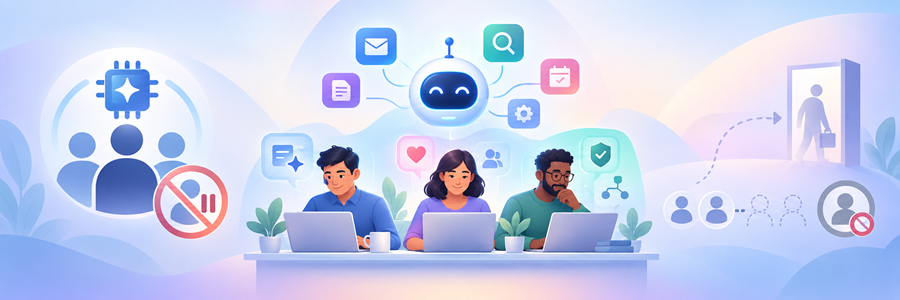
Imagine a support team using an AI assistant to find answers and prepare replies. If the workload stays the same, management might choose not to replace someone who leaves. If customer demand grows, the same team might handle more requests before the company hires again. These are examples of possible business decisions, not a prediction for every employer.
This distinction matters when reading big numbers about AI. The ILO’s 2025 research on generative AI and jobs estimated that one in four workers worldwide is in an occupation with some exposure to generative AI. That does not mean one in four jobs will disappear. Exposure means parts of the work could be affected. The research points to job transformation being more likely than complete replacement.
A job usually contains several tasks. Drafting an email may become easier to automate, while understanding an unhappy client, checking an unusual case, and taking responsibility for the decision still require human involvement.
IT Giants Are Putting AI Directly Into Employees’ Hands
This shift is already visible in announcements from major IT companies. In a June 2026 announcement, Microsoft said Infosys, TCS, and Wipro had each scaled Microsoft 365 Copilot licences to more than 100,000 employees, covering over 300,000 employees together.
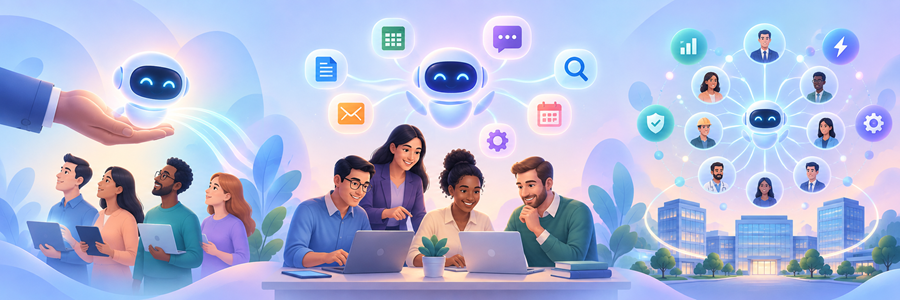
That is a substantial expansion of access. It also needs to be read correctly licensing figures alone do not tell us how effectively every employee uses the tool or how many jobs will change.
Separately, TCS announced a partnership with Anthropic in June 2026 that included plans to equip 50,000 associates with Claude enterprise licences. The proposed rollout covered functions such as engineering, finance, legal, marketing, and sales.
The direction is clear from these announcements AI is becoming part of everyday company workflows, extending beyond developers to people preparing documents, analysing information, and coordinating work. Whether those tools deliver enough value to change staffing is a separate question.
Why Are IT Companies Encouraging AI Use So Aggressively
Think about it from a business perspective. If a team can complete reliable work faster, the company has several options deliver sooner, take on more projects, improve its margin, or operate with fewer people than it otherwise would have needed.

For IT services companies, there is also a client-facing reason. Learning to use AI internally can help them understand what it takes to introduce similar tools into a customer’s business. That includes connecting systems, setting permissions, checking outputs, and supporting people through changes in their work.
There are competitive pressures too. If clients expect shorter delivery times or lower prices, a company may feel pushed to demonstrate productivity improvements. However, these incentives do not tell us which staffing decision an individual employer will make.
AI adoption can support business growth and reduce hiring needs at the same time. The outcome depends on demand, the type of work, and management’s choices about how to use any savings.
The Productivity Question Nobody Can Ignore
Does AI actually make employees more productive? Research suggests that the answer depends on the task, the tool, and the person using it.
A 2025 study published in the Quarterly Journal of Economics examined the introduction of an AI assistant among 5,172 customer-support agents at one company. Access to the assistant increased issues resolved per hour by 15% on average, with larger benefits for less experienced and lower-skilled workers.
That is useful evidence for that setting. It does not mean every employee becomes 15% more productive, or that a company can immediately remove 15% of its staff.
Software development adds another complication. In its February 2026 update on developer productivity research, METR explained that participant selection, task selection, and time measurement made its newer estimates difficult to interpret reliably. Its earlier finding that AI slowed a particular group of experienced developers should not be treated as a verdict on today’s tools either.
For a practical example, suppose an assistant produces a deployment script in two minutes. Someone still needs to check permissions, error handling, secrets, and what happens when a command fails. Time saved while writing can be lost later if the output creates a production problem.
The useful measure is reliable work completed, including review and rework. Counting generated lines of code or prompts does not tell the whole story. Our guide to vibe coding provides some background on working with AI-generated software.
Junior IT Roles Could Feel the Pressure First
Many entry-level responsibilities involve first drafts and repeatable tasks, preparing basic documentation, writing straightforward code, collecting information, or handling familiar support questions. When AI helps existing employees do more of these tasks, companies may reconsider how many junior openings they need.
There is some evidence worth watching. An August 2026 update from Stanford’s Digital Economy Lab, using US payroll data, found weaker employment among young workers in occupations more exposed to AI. The pattern was driven mainly by reduced hiring. The researchers describe their findings as descriptive rather than causal, so they do not prove AI alone caused the changes. They also do not directly measure hiring outcomes for Indian freshers.
This does not mean a fresher should give up on IT. The customer-support study discussed earlier also shows how an assistant can help less experienced people improve their performance. Both possibilities deserve attention.
The challenge for employers is to preserve a route into the profession. Junior employees develop judgement by doing work, receiving feedback, and gradually taking on harder problems. If companies remove too many learning opportunities, they may weaken their future talent pipeline.
Experienced employees should pay attention too. Seniority by itself offers limited protection when a role mainly involves work that can be standardised.
India’s IT Services Model Could Be Heading for a Bigger Change
A useful way to understand the potential pressure is to look at how a project is priced. In a contract billed by time and staffing, fewer hours needed for the same work can raise a difficult question how does the service provider maintain its revenue?

In a fixed-price project, faster delivery could improve the provider’s margin, provided quality remains acceptable. However, clients may eventually ask for lower prices when they believe AI has reduced the cost of delivery. These are possible commercial effects, not a claim that every Indian IT contract is changing in the same way.
Companies may respond by taking on more work, offering new services, or charging for defined outcomes. Employees may find that understanding a customer’s business becomes more important alongside their technical skills.
Consider an older application connected to several business systems. Producing code is only one part of changing it safely. Someone needs to understand the dependencies, the data, the users, and the consequences of an outage. AI assistance does not remove those requirements.
For India’s IT workforce, the question is therefore broader than whether one tool can write a function. It is how teams are staffed, how clients buy services, and which skills help turn a technical change into a dependable business result.
What Should IT Employees Actually Do About It?
You do not need to learn every new AI product that appears. A more useful approach is to improve how you solve real problems and show that you can use the available tools responsibly.
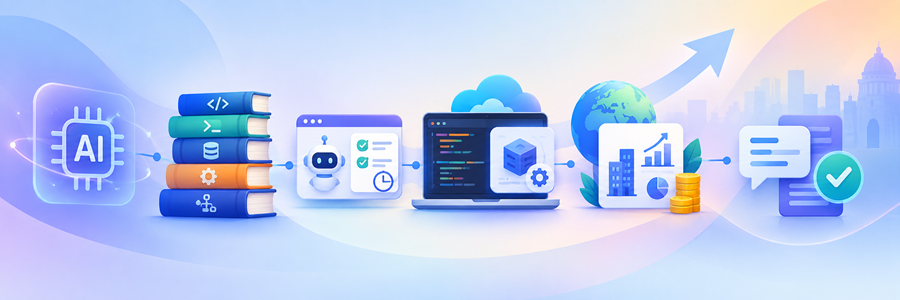
- Keep your fundamentals strong. Focus on the foundations of your role, whether that is programming, Linux, networking, SQL, testing, or customer support. You need enough understanding to recognise when an AI answer is incomplete or wrong.
- Use an approved AI tool on one repeatable task. Try drafting documentation, explaining a test failure, or preparing a first version of a script. Track the time spent checking and correcting it as well as the time saved. Follow your employer’s rules for customer data, credentials, and source code.
- Build a small project you can explain. A working application or deployment pipeline is more convincing when you can describe the choices, tests, and failure cases. Be ready to explain which parts AI helped with and how you verified them.
- Learn the business around your work. Understand what your users need, what a mistake costs, and which constraints matter. That context helps you judge whether a technically plausible answer is actually useful.
- Practise communicating and taking ownership. Explain trade-offs clearly, document decisions, and follow an issue through to resolution. Teams need people who can connect a problem, a proposed solution, and the result.
If you work in DevOps, for example, you could build a small CI/CD project with tests, a manual approval step, and a rollback plan. Our guide on building a simple CI/CD pipeline in Harness can give you a starting point. The learning comes from understanding what happens when the pipeline fails as well as when it succeeds.
These steps can strengthen your position, but no course or skill guarantees job security. Employers also have a responsibility to provide training and explain how AI is changing expectations.
Frequently Asked Questions (FAQ)
Will AI replace all IT jobs?
Should freshers avoid an IT career because of AI?
Is learning to write prompts enough to stay employable?
Does a company introducing AI mean layoffs are coming?
Which IT skills are worth developing alongside AI?
Conclusion
AI can change responsibilities, reduce demand for some routine tasks, and put pressure on hiring. At the same time, company announcements and exposure estimates cannot tell us that every affected job will disappear. For IT employees, a practical response is to learn how AI fits into real work while continuing to build the knowledge needed to check its output. For companies, responsible adoption includes training people and giving new employees a chance to develop. This concludes our discussion on Is the Widespread Use of AI by Companies a Threat to Jobs? Has your company introduced AI tools? Have they made your work easier, changed expectations, or affected hiring in your team? Do let us know in the comments section below. If you want to know Elon Musk’s opinion on AI and work, then check out the blog here. We have a collection of top class web tools baked right into Techdecipher.com. To go to the tools page, click here. If you need any help or have any suggestions to make, then do reach out via the contact page here. I also provide services to help you with your issues, which you can find here. Happy German World Children’s Day!
